The AI Sandwich: Human Expertise, Judgment, and Trust
We are approaching a critical wall in the AI revolution, and it isn’t technical.
The technology is ready; humans are not.
For most employees, the word “AI” doesn’t conjure images of increased productivity or creative freedom. They see a direct threat to their livelihood, a replacement rather than a tool. When organizations ignore this psychological reality, their AI implementations inevitably stall, regardless of how advanced the underlying technology is.
AI adoption is fundamentally a human change problem. To navigate this shift, leaders must lead with deep empathy, while employees must cultivate curiosity and a ruthless commitment to learn, unlearn, and relearn.
The winning strategy is simple: protect the work your people find meaningful. Meaningful work is where employee ownership, pride, and commitment live. Conversely, the monotonous, soul-draining, highly repetitive tasks that nobody actually enjoys are where automation pays its highest dividends. But as we systematically automate these entry-level tasks, we run headfirst into a secondary, much quieter crisis: the collapse of the professional apprenticeship model.
The Death of the Grunt Work Apprenticeship
Historically, professional advancement followed a structured pyramid. Junior employees spent their early years performing “grunt work”—the tedious, repetitive tasks of data entry, draft writing, code debugging, or document formatting.
But this grunt work was never actually busywork. It was the primary mechanism through which real-world expertise was built, one minor mistake and correction at a time.
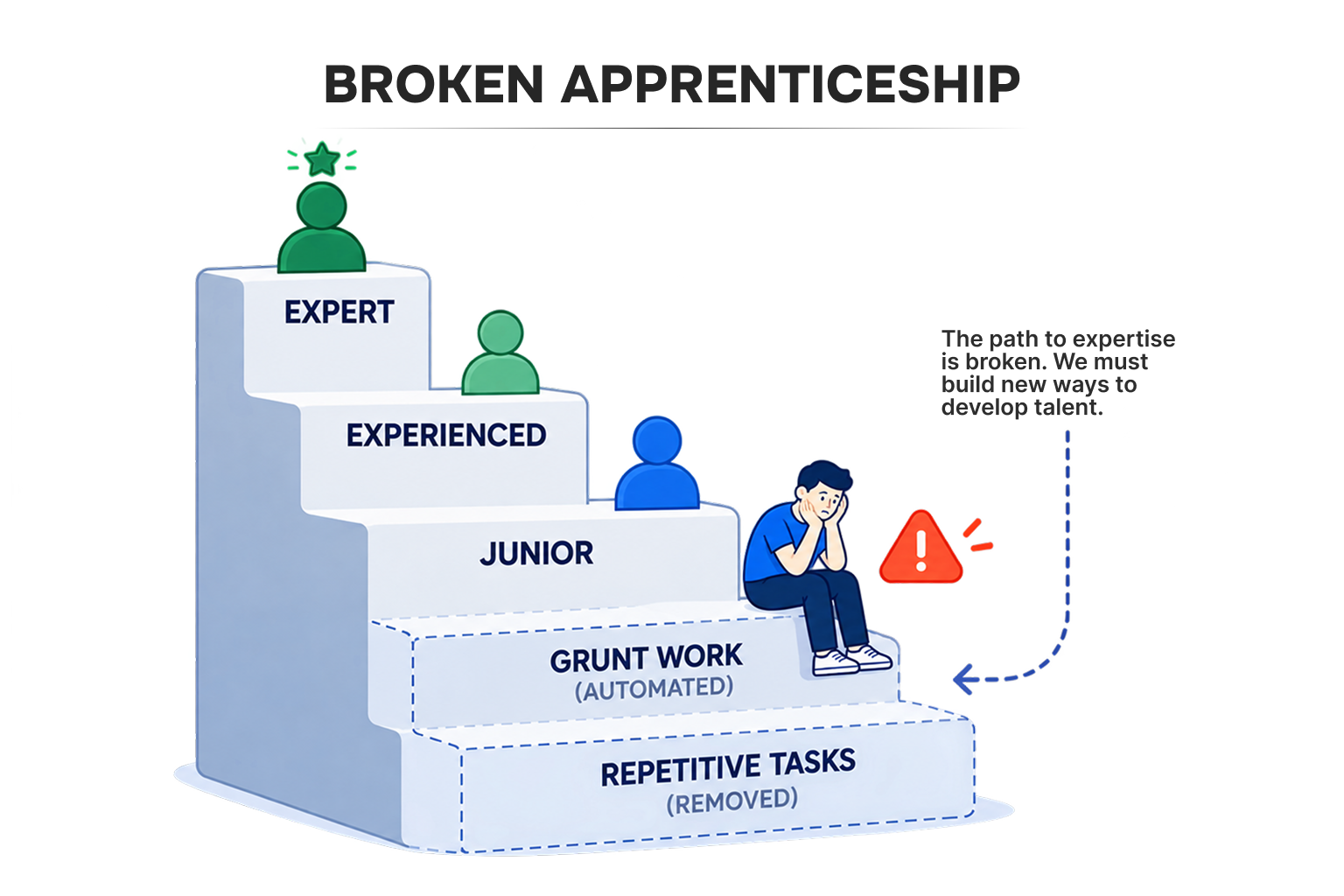
When we automate the bottom of the pyramid, we inadvertently cut the apprenticeship model at its knees. The loss of these foundational “reps” is a massive threat to long-term talent development. If junior staff are no longer doing the execution work, how do they ever develop the deep expertise required to manage the systems?
The mandate for the modern worker can no longer be “do the grunt work faster”. Instead, we must redefine the relationship with our tools: stop competing with the model on execution, and start auditing its output.
Judgment and expertise do not disappear when the repetitive execution reps disappear. However, they must be rebuilt entirely differently—grounded in systematic review and critical evaluation rather than raw doing. This is a far more difficult skill to develop than execution ever was, which is exactly why most professionals will fail to make the transition.
The Tale of Two Engineers and the “AI Sandwich”
To see this skill gap in action, consider a simple scenario: two software engineers are given the exact same development ticket.
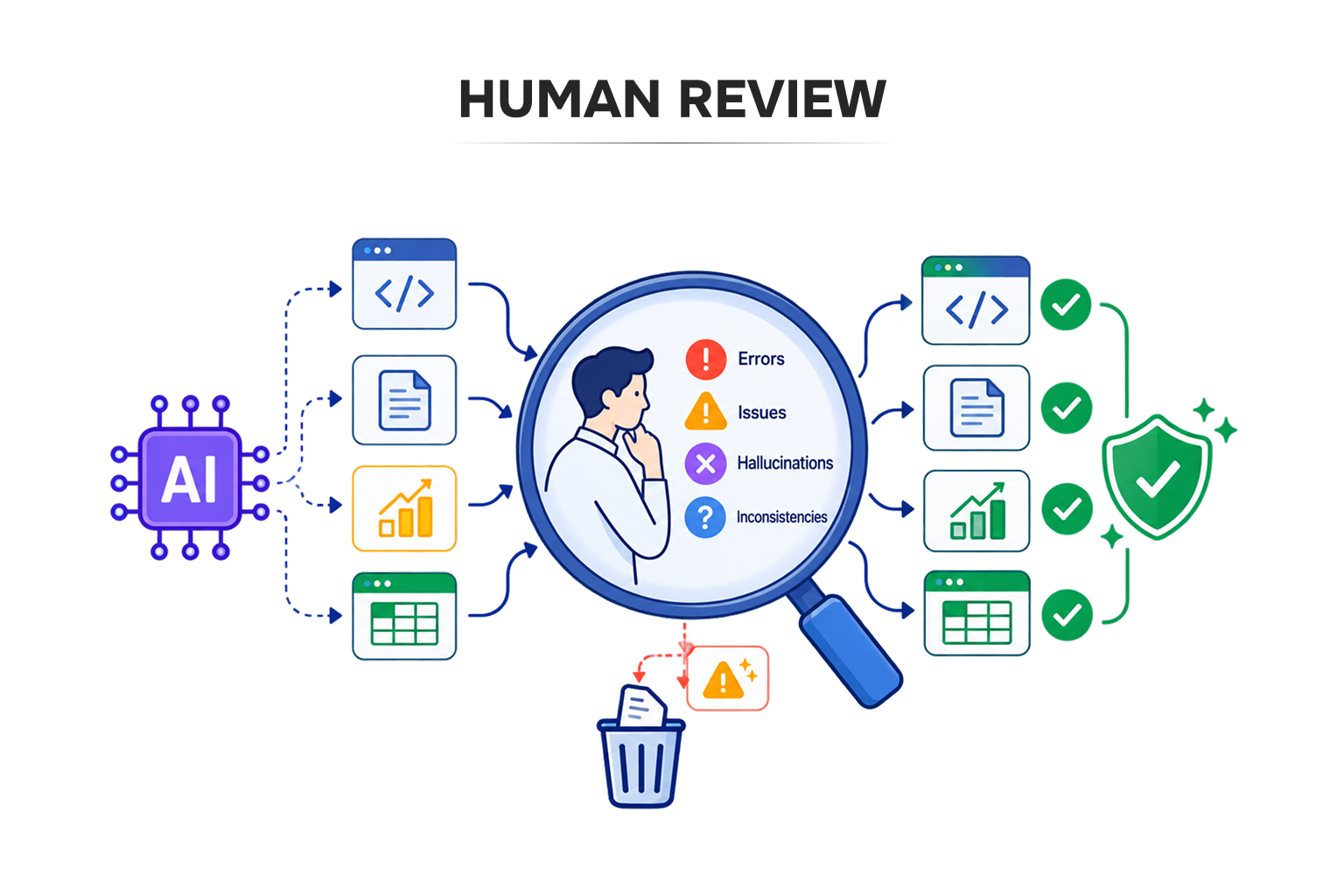
The first engineer takes the prompt, pastes it blindly into Claude, skims the resulting diff, and immediately merges the code. Three weeks later, production breaks. Why? Because a critical configuration value was silently changed by the model for no logical reason, and the engineer lacked the focus to spot it.
The second engineer approaches the same ticket. They scope the repository first, run targeted skill files to keep the pull request as minimal as possible, read every single line of the generated diff, and catch the stray, erroneous configuration change before it ever goes near production.
Both engineers used the exact same tool for the exact same ticket. The difference between success and catastrophic failure was not technical capability, but evaluation and oversight.
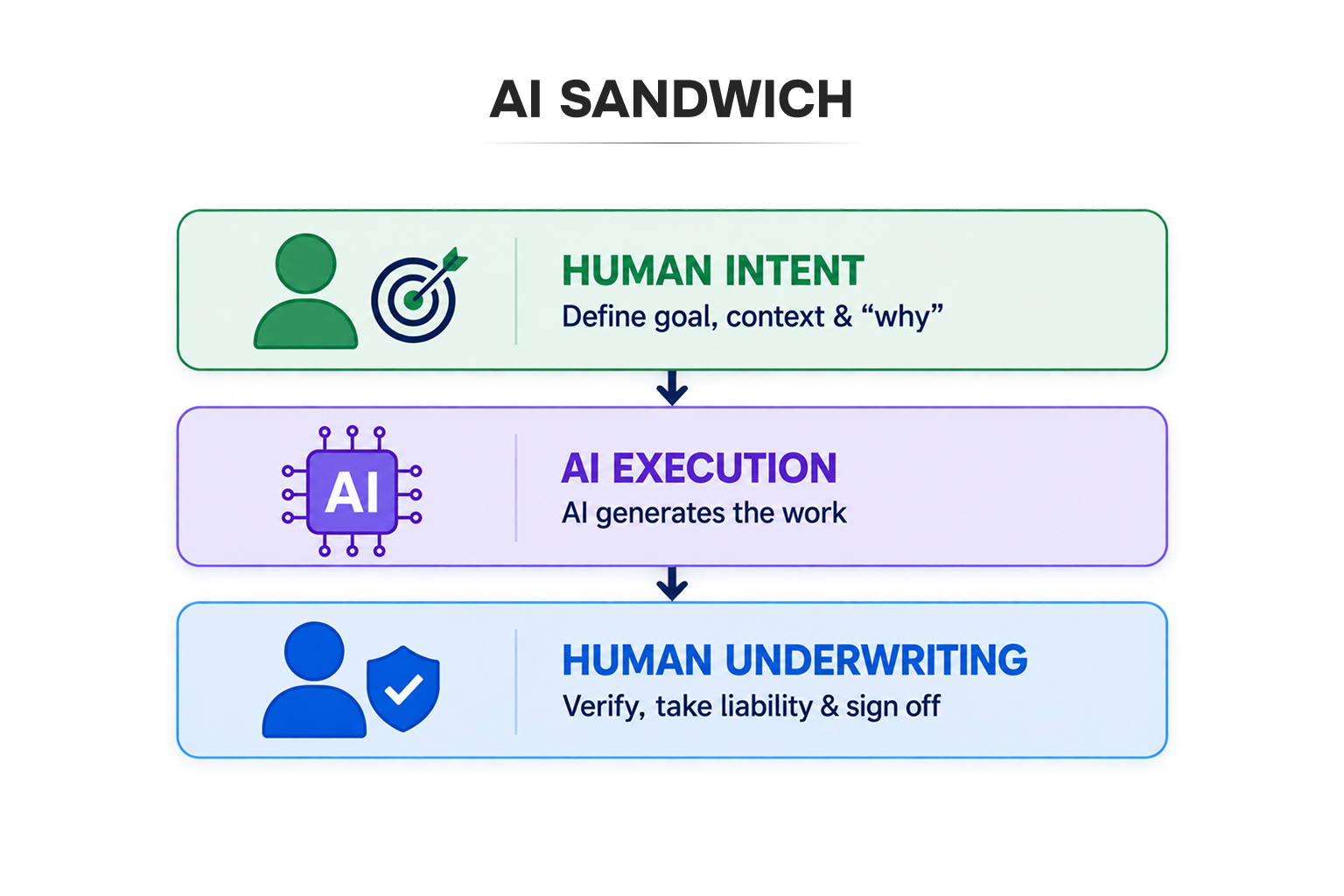
This operational framework is what we call The AI Sandwich: AI executes, humans underwrite.
Underwriting means thoroughly verifying AI-generated output and accepting full legal, financial, and professional liability for the final outcome. In this new era, professionals will no longer be paid for raw output; they will be paid for what they are willing to sign off on.
Does your team currently possess the capacity to catch the slop, push back on the model, and sign off safely? If not, you are sitting on an operational time bomb.
Intention vs. Optimization: The Mastery of Context Engineering
While underwriting protects the tail end of the workflow by catching errors, its success depends entirely on what happens at the front end: how humans define the operational problem before execution even begins.
Consider a fundamental question: How do you eradicate a disease? Do you eliminate everyone who carries it, or do you find a cure?
Both are technically “solutions” to the raw metric of disease eradication, but they represent two completely different readings of the problem. One destroys the system’s purpose to optimize a proxy metric; the other cures it. This is the exact danger we face with AI: the conflict between intention and optimization.
An optimizer does not ask why a goal matters; it simply runs toward the mathematical objective. Even an AI model that claims to “understand” your intent is merely inferring it from the context you provide.
If your context is thin, vague, or incorrect, the model will not push back. It will confidently fill the gaps with its best guess and run at lightspeed in the wrong direction.
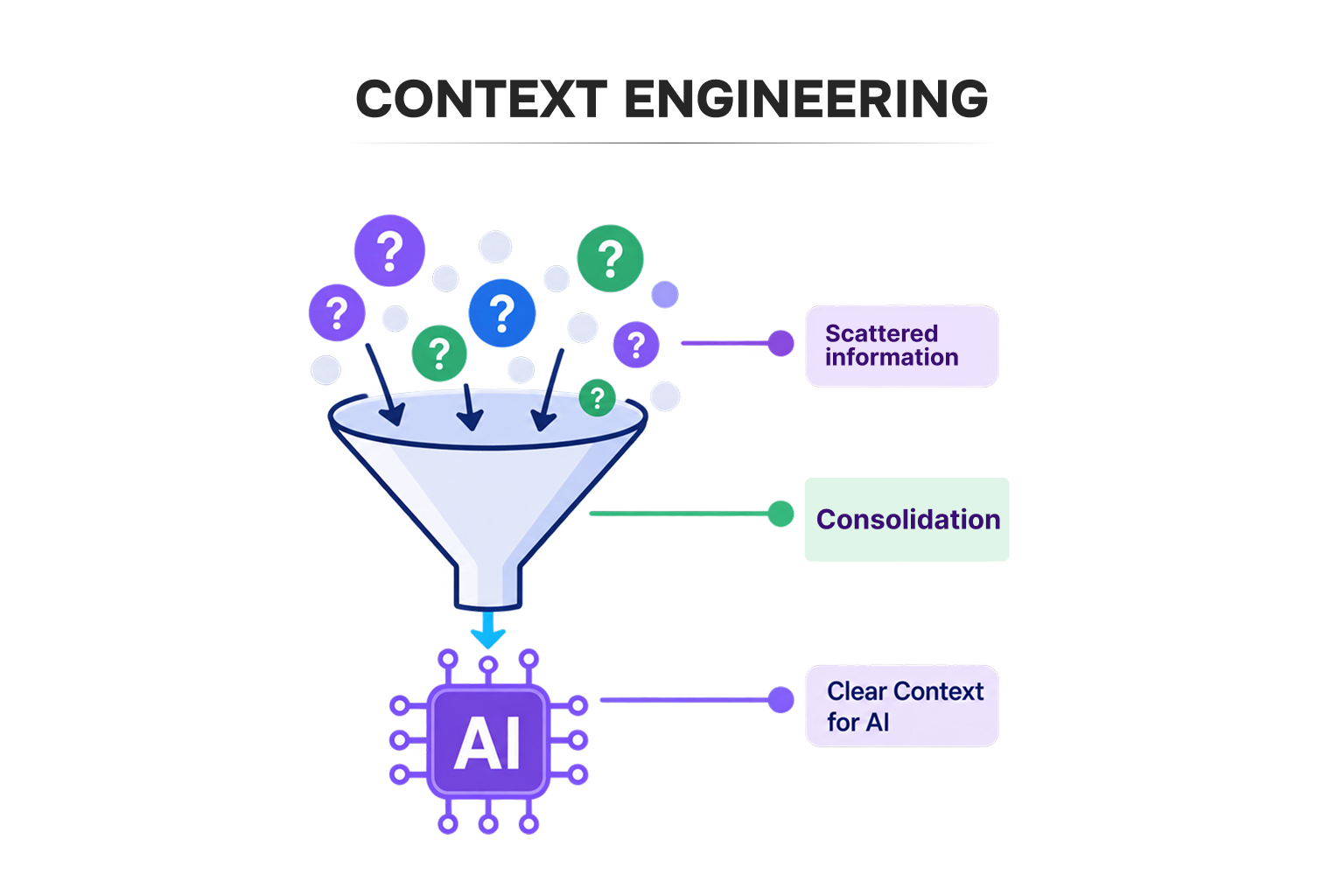
Deciding what is worth instructing the model to do, and catching when an objective is poorly defined, remains a strictly human job. This is the discipline of Context Engineering.
Context engineering asks: What does the model need to know, and how do we get that exact information in front of it (reliably, at the right time, and in the right format) every time it is asked?
Intelligence alone is not enough; directional intent is what makes intelligence useful. While AI may own the “what” and the “how,” humans must ruthlessly own the “why”.
Rebuilding Your Team’s Capacity
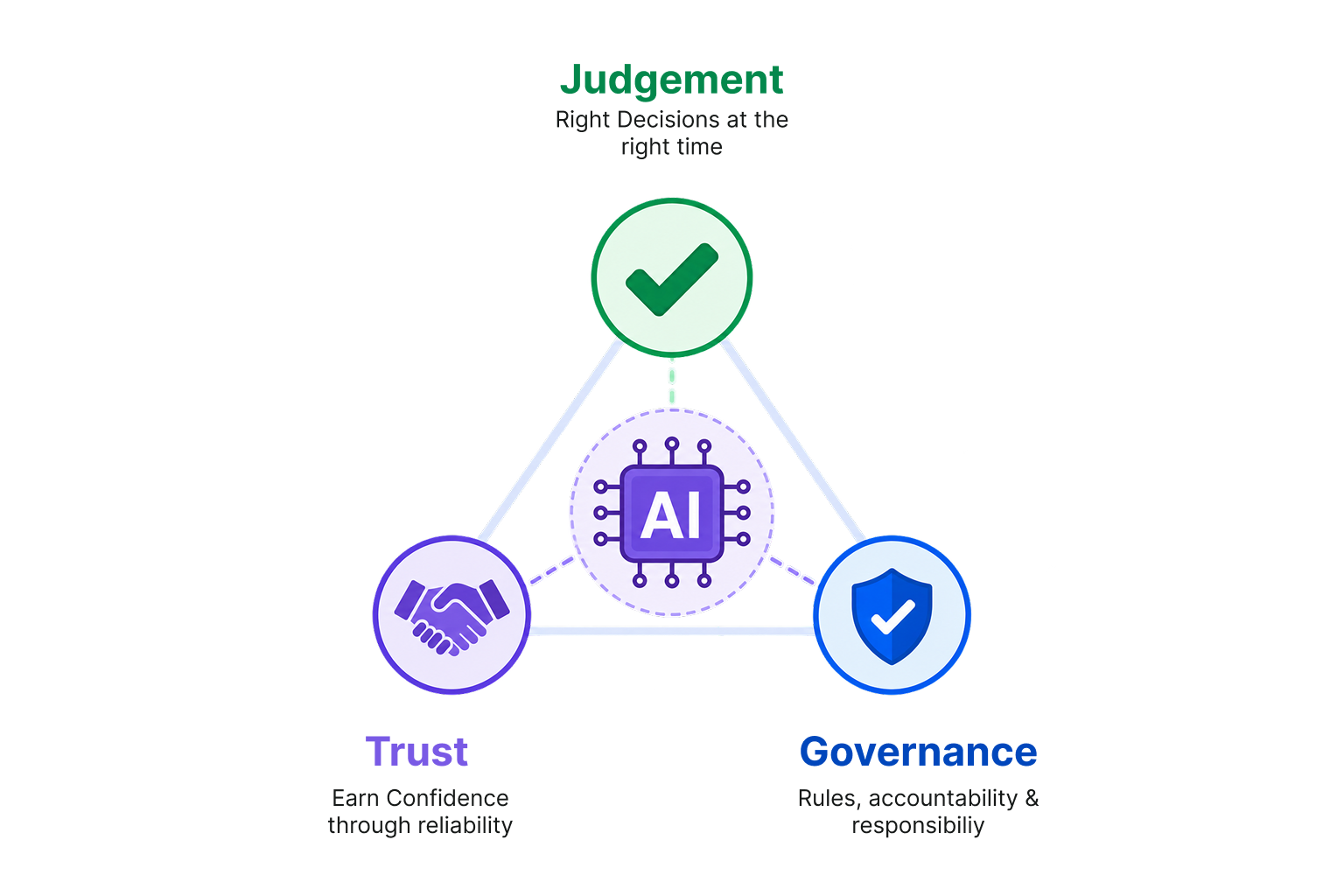
As execution is commoditized, the value of human talent migrates to three core pillars: trust, judgment, and governance. When any generic tool can generate a highly plausible answer, the premium shifts entirely to the human who can verify, govern, and trust the output.
Evaluating this capacity is the core of a our AI Readiness Assessment. To prepare your workforce for the AI Sandwich era, you must begin building these underwriting and context habits today:
Shift metrics from volume to fidelity: Stop rewarding employees for how much they produce, and start measuring how effectively they catch errors and refine AI-generated work.
Formalize Context Engineering: Treat context design as a core professional skill. Teach your team how to capture institutional context so they can feed models sharp, specific data instead of generic prompts.
Establish clear liability protocols: Define exactly who is responsible for “underwriting” each automated process. Ensure that no AI-generated work is shipped or actioned upon without a human signing their name to the liability.
Build “synthetic baseline” training for junior staff: Replace lost repetitive execution reps with mandatory code reviews, diff-auditing rotations, and failure-mode simulations so entry-level talent learns how to spot machine errors before they are given signing authority.
The future belongs to the underwriters and context engineers.
Stop training your teams to compete with the machine, and start training them to run it.
Shift their identity from vulnerable task-executors to essential, high-value guardians of quality and trust.