The Silent Economics of AI Software: From Niche Disruption to the Vibe Coding Time Bomb
What happened to media over the last two decades is now happening to technology.
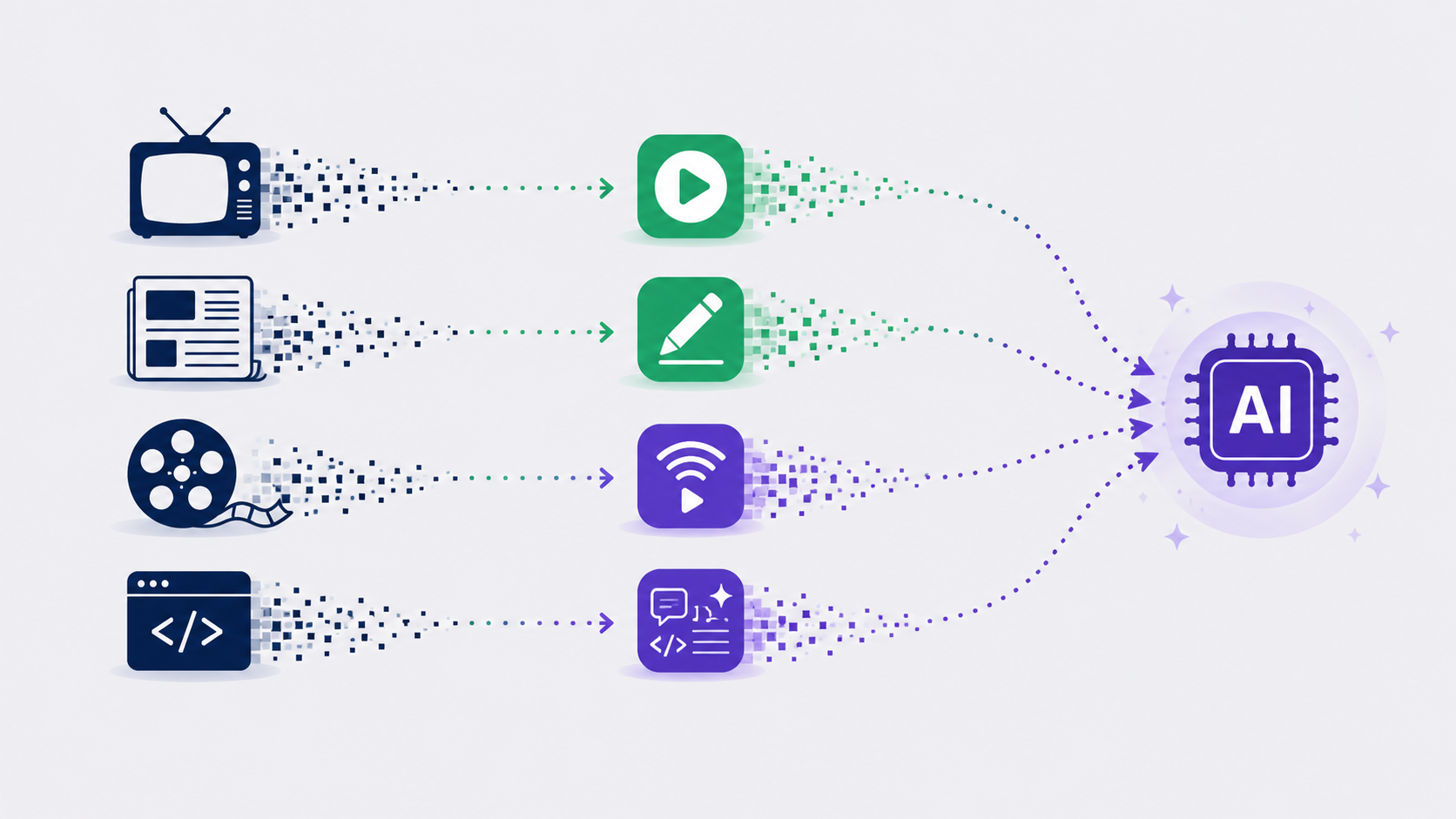
The broadcast industry did not see YouTube coming. Traditional publishers did not foresee the rise of independent bloggers. Legacy film studios did not anticipate the disruption of streaming services like Netflix. In each case, a centralized, high-cost model was completely bypassed by low-cost, abundant, and hyper-personalized distribution.
Today, software is becoming like content: abundant, niche, personal, and unstoppable.
However, there is a fundamental difference. Media was passive, you simply consumed it. Software is active. It executes, changes how you work, and rewrites your expectations.
The primary driver behind this shift is a collapse in the economics of building software.
AI-powered lean teams can now design and ship products that previously required enterprise budgets and years of development. These small teams do not compete on massive enterprise scale; they compete on precision, fit, and speed. They deliver niche, highly tailored tools with seamless user experiences, free of enterprise bloat.
No industry is exempt from this disruption. Software is aggressively penetrating spaces that were previously unreachable due to high development costs. But this democratization of creation has a severe, silent side effect: the rise of the Vibe Coding Time Bomb.
The Vibe Coding Time Bomb
In tech circles, there is massive celebration around “vibe coding”. It is the practice of building functional apps over a single weekend, or completing complex tasks in unfamiliar tech stacks using natural language prompts.
The speed of this development is undeniably real, but the perception of accomplishment is a dangerous illusion. We have mistaken the temporary ability to assemble software with the ability to engineer systems.
Vibe coding is like planting operational landmines that will eventually detonate. Imagine buying a luxury home. On the surface, it features fresh paint, beautiful furniture, and perfect lighting. It looks absolutely complete. But weeks after moving in, you discover cracked foundations, leaking pipes, and faulty wiring hidden deep behind the drywall.
AI-generated software increasingly matches this metaphor: beautiful interfaces masking critical, hidden structural flaws.
The app works fine for a handful of test users, but very few developers validate whether their weekend-built system can actually survive:
- 100,000 active users
- Targeted security attacks
- Constantly shifting business requirements
- Complex software integrations
- Strict regulatory compliance and data audits
- Five years of ongoing system maintenance
AI can solve these architectural challenges, but only when a highly experienced developer knows exactly how to ask it.
Ultimately, AI has not eliminated the need for technical experts; it has merely delayed the painful moment you realize you desperately need one. And when that moment finally arrives, the cost of remediation is far higher than you ever anticipated.
The easiest software to build is always the hardest to maintain. In the AI era, experienced software engineers are rapidly transitioning from creators to forensic investigators. The skill required to clean up, debug, and maintain unoptimized, machine-generated code is becoming far rarer (and far more valuable) than the skill required to generate it in the first place.
What’s Your Strategy When the Subsidy Ends?
Fragile code isn’t the only hidden risk in AI-generated software; your underlying business model might be carrying an equally volatile financial liability.
Even if your code is clean, your business model might be resting on a highly unstable financial foundation.
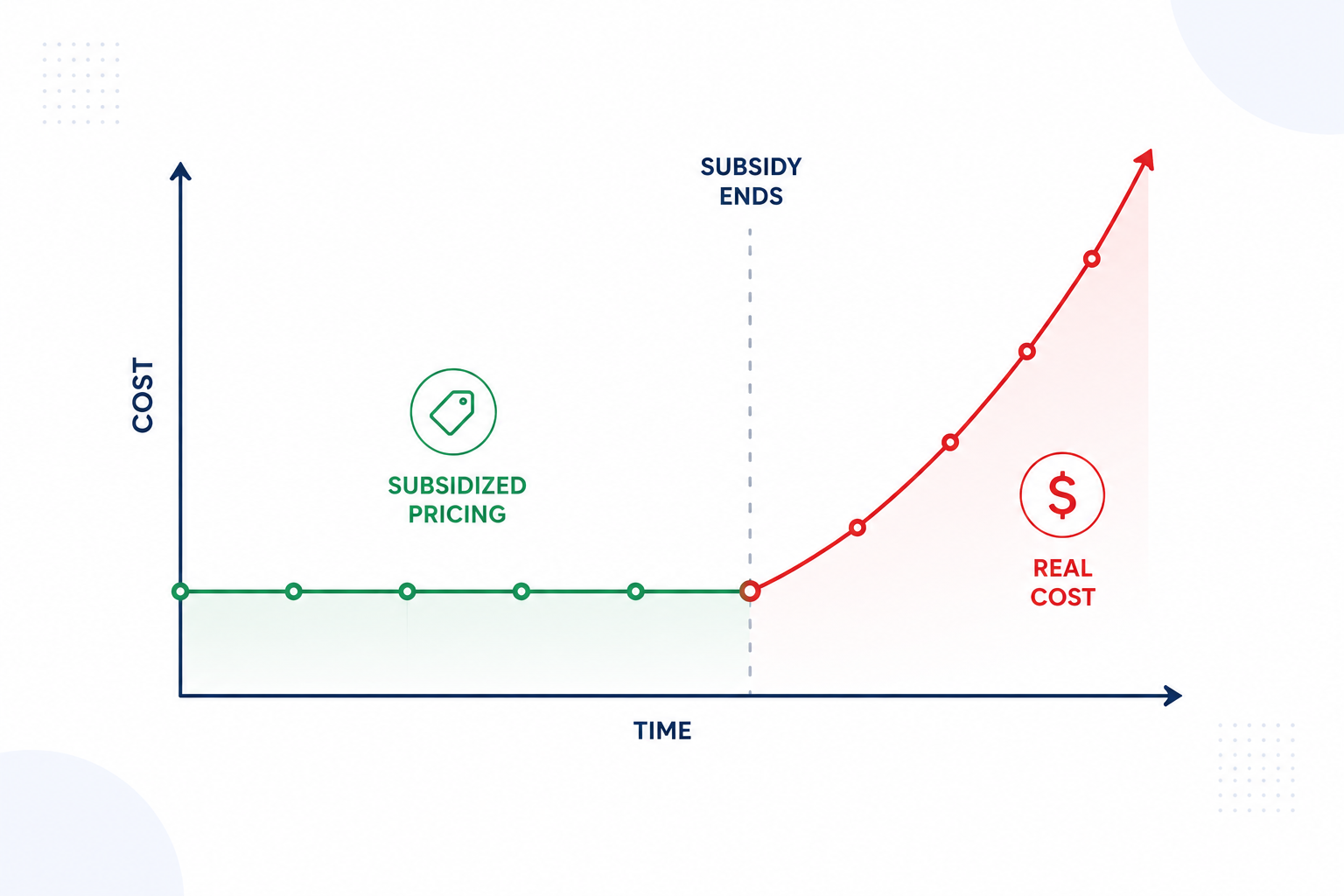
Right now, major model providers are engaged in a brutal price war, burning venture capital to capture market share. This aggressive discounting has led to massive API price cuts, making many AI startups and software products look far more profitable than they actually are.
But these model subsidies will not last forever. What is your strategy when the subsidy ends?
If model inference costs stop falling, or if providers decide to finally monetize their infrastructure, the economics of your software will shift overnight. Your customer revenue will remain fixed, but your underlying cost of goods sold (COGS) will spike dramatically. Instead of compounding your profit margin, growth will begin compounding your monthly API bill.
The standard, lazy response to this threat is to try and use fewer tokens. A far more robust response is to need fewer tokens.
Every API call you make is technical debt carrying a monthly financial bill. An LLM should not sit in the critical path of every single user interaction. To build a financially resilient AI product, you must design around these fundamental economic guardrails:
Leverage models to build and structure the application during development, rather than relying on them to run basic, repetitive logic at runtime.
If a feature can be solved with a fixed database query, standard logic, or a simple algorithm, keep it there.
Treat inference as a financial tax on your business. Pay it only when live, contextual reasoning is strictly necessary.
Build your systems to process actions deterministically first, escalating to the expensive cognitive loop of an LLM only when the system encounters true novelty.
Specificity: Your Only Sustainable Moat
If building software is cheap and public models are accessible to everyone, where does your long-term business moat actually live?
It does not live in your code, and it certainly does not live in your generic prompts.
AI models are trained on massive, global datasets. Because they have absorbed more text than any human could read in a thousand lifetimes, they are highly capable of cross-pollinating concepts across domains. However, without highly specific, sharp direction, the model plays safe. It defaults to returning the most statistically probable answer—which is, by definition, the most average answer.
Limited context yields average software. To break through the “average answer” trap, you must feed the model your unique voice, your proprietary operational data, and your highly specific context.
Your proprietary specificity, multiplied by the model’s scale, is your actual unfair advantage.
When the underlying model is public, your internal data and domain-specific context become your only defensible differentiators. The value of software does not disappear; it simply migrates from the code itself to the proprietary context you wrap around it.
Auditing Your Software Exposure
To survive the shift to abundant software, organizations must build with extreme engineering discipline. The smart play is to conduct an AI Process Audit to map exactly where your software operations are exposed:
- Identify where you are overpaying the “inference tax” on simple, deterministic workflows.
- Uncover where fragile, vibe-coded apps have been silently deployed without adequate security or architecture reviews.
- Pinpoint where your proprietary domain context is leaking, and build structured repositories to capture it safely.
- Audit your model dependence. Stress-test your financial model by calculating intelligence cost under a 3x API price increase to ensure profitability survives the end of provider subsidies.
Building software is cheaper than ever, but engineering resilient, profitable systems remains incredibly hard.
Audit your technical layout before the pressure of the market makes it urgent.