Your AI Native Business Roadmap Starts Here
AI just expanded what your business could be.
And now you’re not sure about the new vision of your business.
Which one are you?
- You went all in. Moving fast. Betting big. And now you’re hitting walls your infrastructure was never built for.
- You’re holding back. Caution and “safe” have quietly turned into “stuck.”
- You are overwhelmed. Where to start? What is the actual value here? You can’t even define the shape of the problem AI can solve.
Three camps. Same technology in front of all of them.
Different symptoms. Same disease.
Call it what it is: confusion, just wearing three different outfits.
AI isn’t confusing. Knowing what to do with it is.
That’s not a tech problem. That’s a roadmap problem.
Nobody in any of these camps has an honest picture of their own business.
That’s the real confusion.
And if that stings a little, good.
It should.
Every C-level I talk to is drowning in the same noise. ChatGPT this. Agent that. “AI will replace your entire workforce.” “AI is just hype.” “You need a custom LLM trained on your proprietary data.” “Use this off-the-shelf tool; I heard good things about it.”
Nobody knows what to believe, so most leaders do the most dangerous thing possible:
Nothing.
They keep reading. They keep “researching.” They buy tools with big promises and call it their AI strategy. They throw a ChatGPT enterprise license at the team and hope for a magical outcome. They’re busy. They have 47 tabs open and a running list of AI tools someone told them to try.
But if you ask them what they’re actually going to change this quarter?
Silence.
Here is what nobody tells you about AI adoption in the enterprise:
The real problem is diagnosis. And the diagnosis problem is this: you cannot prescribe a cure before you understand the disease.
Right now, somewhere in your business, your best people are spending 40% of their week on work that a reasonably clever piece of software could do in seconds. Your operations have matured into a shape nobody remembers designing. You are losing margin to friction you cannot even see. Friction buried inside handoffs, approvals, reports, and meetings that everyone attends and nobody questions.
Before solving the technology problem, you need visibility into the work.
You cannot fix what you have not found.
After intelligence is available as a service, most leaders feel this vague unease. Things have become slower. Decisions take longer than they used to. Good people leave and cite “inefficiency” in their exit interviews. The business is working, just not as well as it could be, and nobody can quite point to why.
That signal is real. And it is pointing at something specific.
Buying tools is not a strategy. The winning companies know how work actually moves through their organisation, where it accelerates, where it stalls, where it disappears, before they spend a dollar on technology.
Most companies skip this step entirely. They hear “AI” and immediately think deployment. Implementation. Vendor calls. They are solving for a future state without understanding the current state.
So before the vendor calls. Before the pilot programs. Before the budget allocation. The single most valuable thing a leadership team can do is answer three questions:
- Where are our best people underutilised?
- Where is friction costing us money we are not measuring?
- What does the AI-powered version of our business look like?
These are business questions with technology implications.
The one who can answer it will be the one best positioned to create it.
That is the work. And it starts before the tools.
There is exactly one correct first move. The AI process audit.
An honest, rigorous, slightly uncomfortable examination of how work actually happens inside your company. Where time goes. Where errors live. Where your people have silently accepted friction as part of the job because nobody ever asked them what hurts.
And before you think this sounds like consulting fluff, let me walk you through what it actually looks like.
Download our free AI Readiness Assessment guide.
Step 1: Talk to the people doing the work. Not just the people managing it.
When was the last time you sat with someone on your operations team and asked them to walk you through their Tuesday?
Forget the job description. Forget the org chart. Look at their actual Tuesday.
Most leaders have no idea what their employees’ real workflows look like. They know the outputs. They know the dashboards. But the 17 clicks between system A and system B? The spreadsheet that exists because the CRM export is broken? The manual data entry that everyone quietly assumes is just “part of the role”?
That is where your margin lives. And it is invisible from the 30,000-foot view.
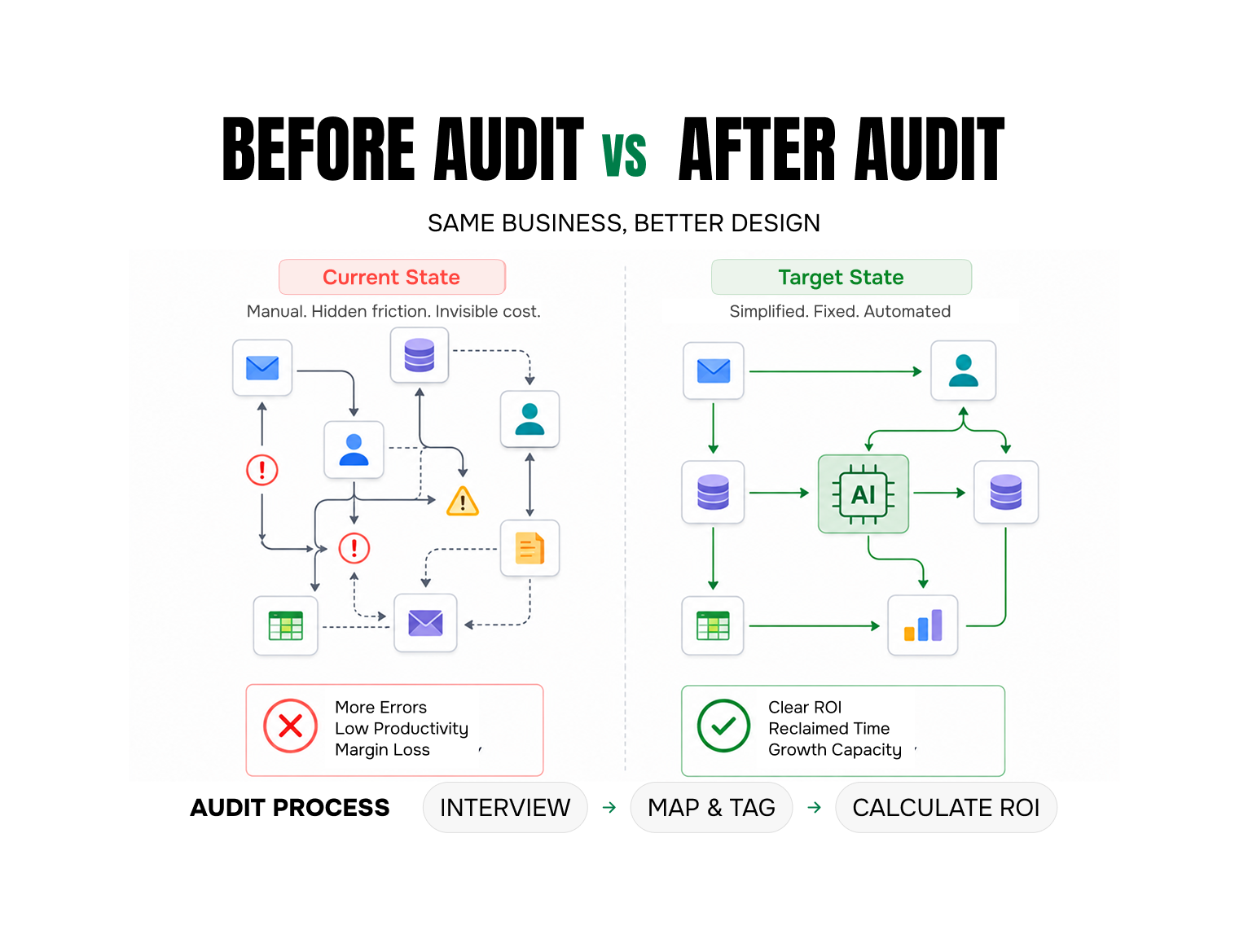
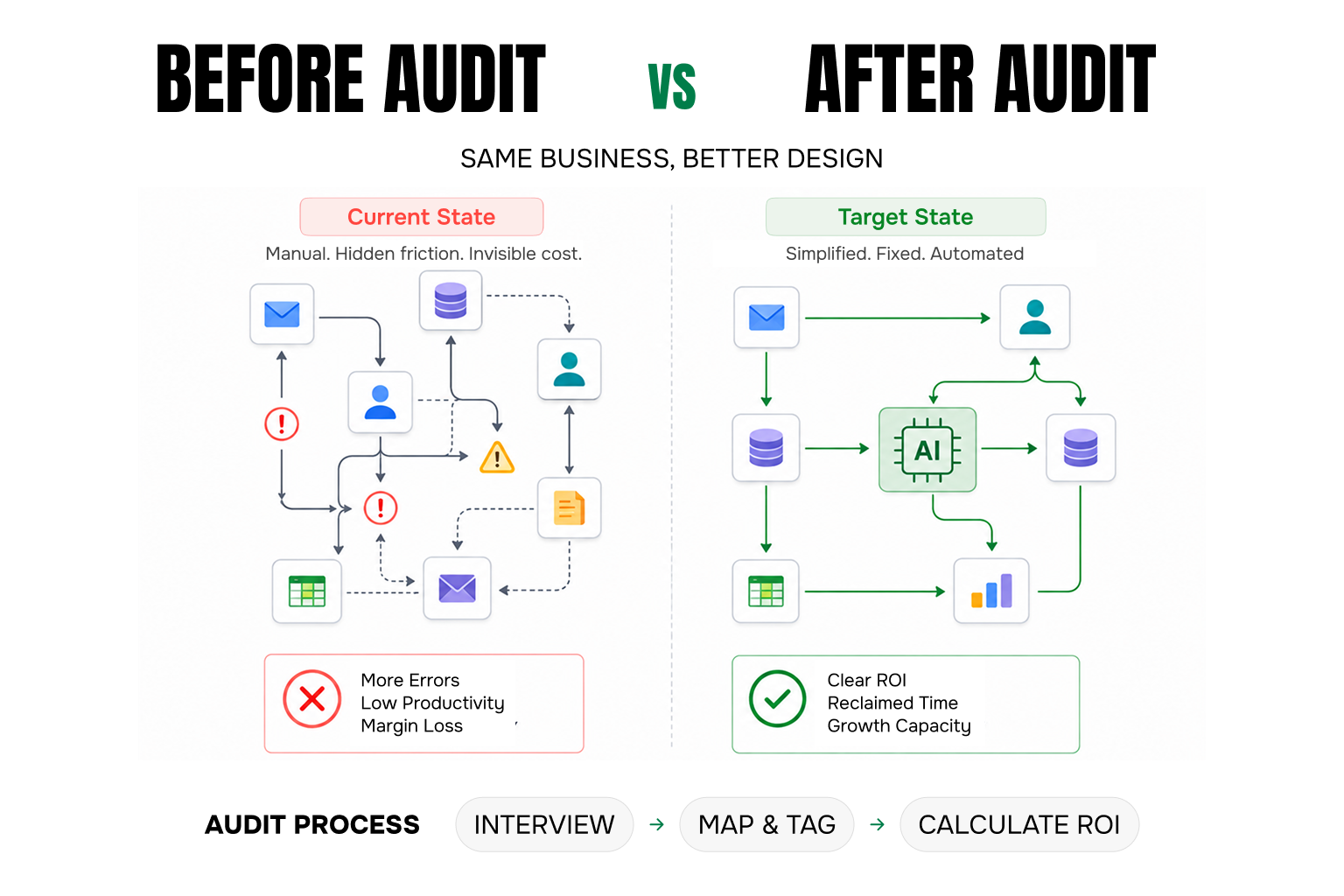
A proper audit starts with two conversations. The stakeholder interview gives us the strategic picture: what matters, what hurts, what leadership thinks the problems are. The end-user interview gives us the ground truth: the repetitive tasks, the quality risks, the quiet resignation of people who have stopped expecting things to improve.
The gap between those two perspectives? That gap is money.
I have seen companies where the CTO believed the onboarding process was “mostly automated” while three account managers spend 11 hours a week each manually copying data between four different systems. Nobody had ever asked them. They had just accepted the copy-paste as part of the job.
Step 2: Map it. Then find the yellow tags.
Once you have done the interviews, you stop guessing and start seeing.
You build a visual map of how your business actually operates. Every process. Every handoff. Every system. You break it into three engines: how you acquire customers, how you deliver value, how you support people after the sale.
And then you tag the friction.
Time sinks. Steps that consume hours of human attention for no reason beyond “it has always been done this way.”
Quality risks. Processes where the volume and repetition make human error inevitable.
Every yellow tag on that map is a candidate for AI. Because AI is exceptionally good at pattern recognition, data extraction, classification, and generation. And most of what you just tagged is some variation of “a human is doing something repetitive that requires zero judgment but happens to involve cross-referencing information from multiple sources.”
That is a script waiting to be written. An API call to be made.
Now you plot each opportunity on a two-by-two: business impact versus implementation effort.
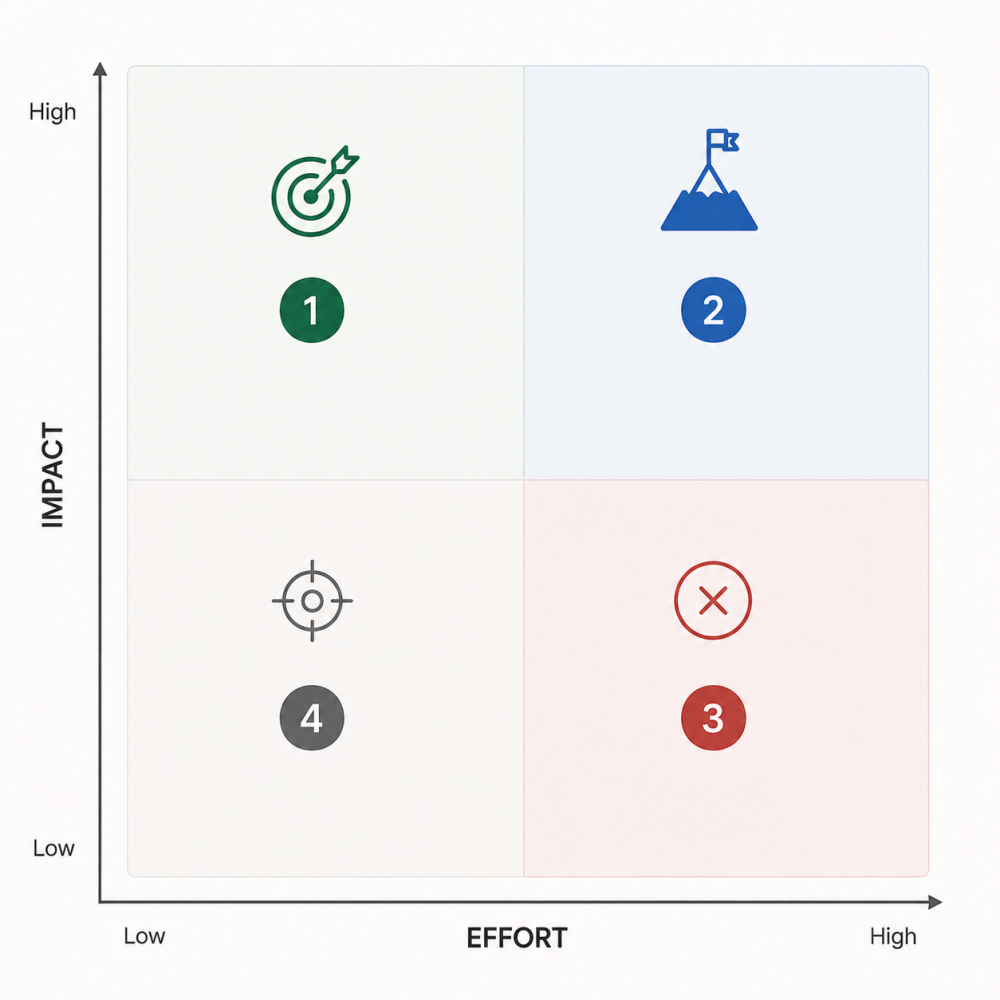
Impact vs. Effort
Some things land in the top left. Low effort, high impact. Quick wins. These are your first swings. Automating invoice processing. Generating client reports. Routing support tickets. Things that sound small but compound into thousands of hours across a year.
Some things land in the top right. High effort, high impact. Big swings. These are your roadmap for the coming quarters. Custom models. Workflow agents. Things that fundamentally change how a function operates.
And some things land in the bottom right. High effort, low impact. Bad ideas dressed up as innovation. You kill these immediately. That is also valuable. The audit does not just tell you what to build. It tells you what to ignore.
Step 3: Do the math. Map the ROI.
This is where most technical assessments fall apart. They present capabilities. They do not present ROI.
A real audit ends with a money slide.
Not a vague “AI will make you more efficient.” A specific calculation. Sarah spends 14 hours a week on data reconciliation. Her fully loaded cost is $62 per hour. That is $45,136 per year. An automated pipeline reduces that by 85%. Implementation cost: $12,000. First-year ROI: 220%.
Now do that for five processes. Ten. Twenty.
Suddenly, AI is not a philosophical conversation about the future of work. It is a spreadsheet that makes the CFO lean forward.
But there is another number most audits miss.
When you give Sarah 12 hours back each week, what does she do with it? If 50% of that reclaimed time shifts toward revenue-generating activities (client relationships, upselling, strategic projects that have been sitting on a backlog since 2022), you are not just cutting costs. You are creating capacity for growth.
That is the difference between an audit that checks the boxes and an audit that makes the business case undeniable.
The only thing stopping you is the decision to look.
Is AI really confusing?
Nope.
The AI marketplace is confusing. The noise is confusing. The fear is confusing. But the technology itself is remarkably simple: identify a defined, repetitive cognitive task, and it can probably do it faster and more accurately than a human.
So what’s the hard part?
The hard part is admitting you do not know where the friction is. Knowing that you have been operating on assumptions. That your org chart does not reflect your actual workflows. That there are processes inside your company nobody has examined in five years because “they work” even though they work poorly and at tremendous hidden cost.
That is what an AI audit forces you to confront. And that is exactly why it is the first step.
No vendor demo. No pilot program. No prompt engineering workshop.
A methodical, interview-driven, evidence-based examination of how work actually gets done, followed by a prioritized map of exactly where AI creates the most value for the least effort.
Everything else is guessing. And guessing is expensive.
Start with the audit. Everything that comes after will be obvious.
To find your ground truth, access our free AI Readiness Guide and see where your business actually stands.