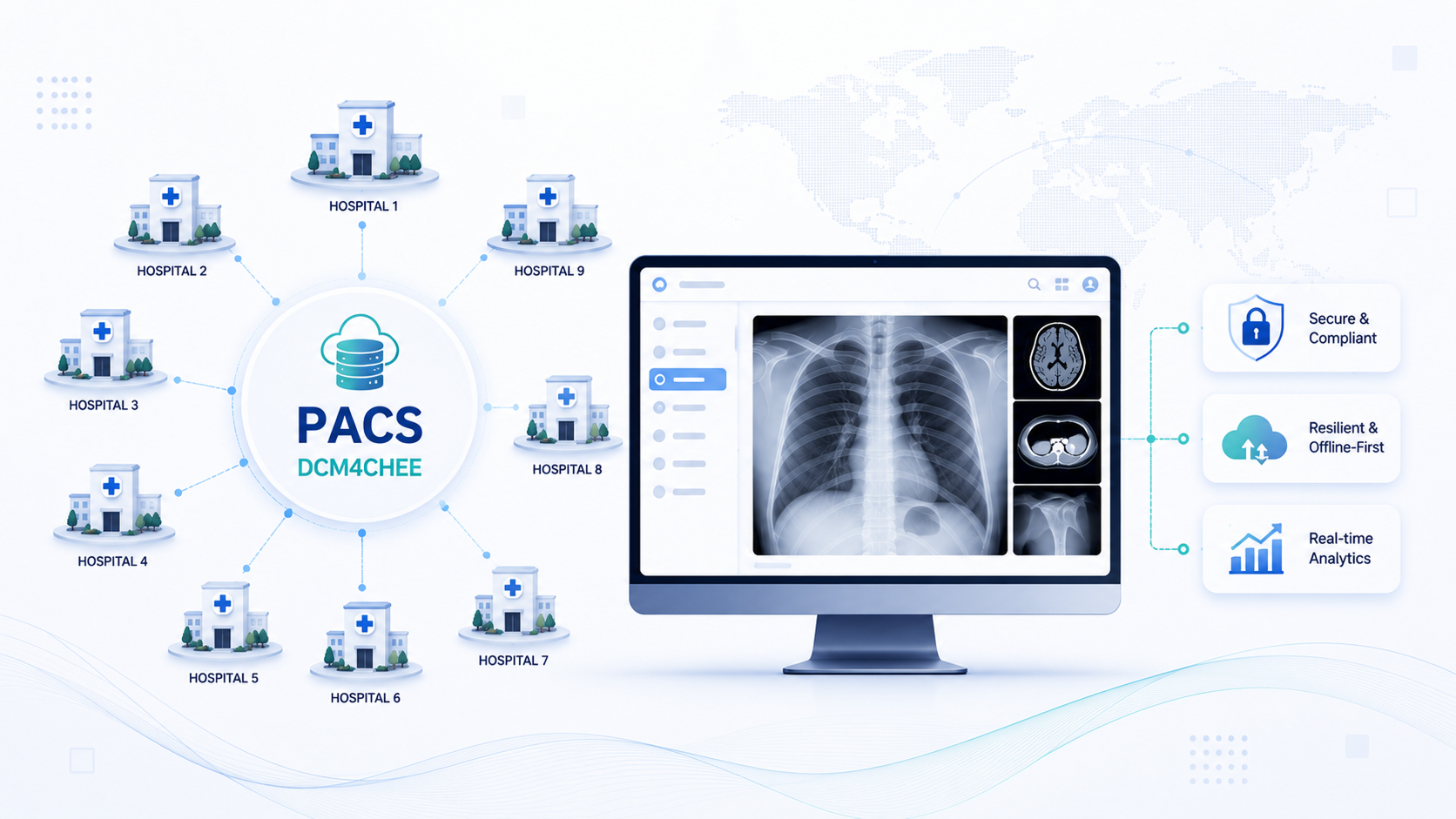
In many developing regions, healthcare providers face a daunting challenge: delivering timely, secure, and reliable diagnostic imaging in environments where infrastructure gaps and budget constraints are the norm. For nine hospitals spread across resource-limited settings, the reliance on analog imaging—films and CDs—meant diagnosis delays of up to 24 hours, frequent loss of studies, and fragmented workflows that hampered patient care.
The Challenge: Analog Bottlenecks and Infrastructure Gaps
Before digital transformation, these hospitals struggled with:
- Manual, film-based imaging workflows that delayed diagnoses and increased the risk of lost or damaged studies
- Fragmented infrastructure, with over 60 machines (CT, MR, XA, etc.) lacking DICOM interoperability, resulting in siloed and inefficient processes
- Unstable power and internet connectivity, threatening data integrity and system reliability
- Budget limitations that made proprietary PACS solutions unattainable
- Privacy and compliance concerns, given limited IT governance and the sensitive nature of patient data
The Solution: Affordable, Secure, and Interoperable PACS
IBS Digital implemented a resilient, DCM4CHEE-based PACS tailored for the realities of developing healthcare environments:
Over 60 imaging modalities—including legacy and modern devices—were integrated via DICOM, breaking down data silos. Custom APIs enabled seamless connection to existing EMRs, ensuring vendor neutrality and future flexibility.
End-to-end SSL encryption, role-based access control (RBAC), and comprehensive audit logs provided robust data protection, aligning with local and international privacy standards.
Offline-first workflows allowed cached studies during outages, with automatic syncing when connectivity resumed. JPEG lossless compression reduced storage costs by 50%, making digital archives sustainable even with limited budgets.
The architecture included a roadmap for microservices (React frontend, FastAPI backend), supporting scalability and cloud migration for AI-driven diagnostics in low-bandwidth environments.
Technical Implementation Highlights
| Backend | DCM4CHEE (DICOM standard) with tiered hot/cold storage for efficient archiving |
| Integration | Custom REST APIs bridged PACS with EHR systems, while DICOM SR conversion enabled even non-compliant devices to participate in digital workflows |
| Frontend | A web-based viewer and analytics dashboard empowered clinicians with real-time access and insights |
| Security | SSL/TLS for data in transit, AES-256 for data at rest, RBAC with AD/LDAP integration, and full DICOM audit trails |

Impact: Faster Diagnoses, Lower Costs, and Reliable Uptime
|
92%
Faster diagnosis, from 24 hours to under 2 hours
|
50%
Reduction in storage costs through lossless compression
|
99.9%
System uptime despite power and network interruptions
|
84,000+
Studies processed annually with zero data loss
|
Lessons Learned and Future Roadmap
- Custom API development was essential for interoperability and EHR adoption
- DICOM wrapper services enabled legacy device integration, extending the life of existing investments
- Clinician buy-in was driven by real-time analytics and improved workflow compliance
Looking ahead, IBS Digital is advancing toward microservices-based architectures and cloud migration (AWS HealthLake Imaging), enabling federated learning and AI-powered diagnostics. Planned modules include anomaly detection and outcome prediction using advanced machine learning techniques.
Key Takeaways for Developing Markets
- Cost-effective: Open-source DCM4CHEE eliminated six-figure licensing fees
- Privacy-compliant: Robust security and auditability met regulatory requirements without expensive third-party tools
- Infrastructure-agnostic: Designed to withstand unstable environments and limited resources