Every major technological wave forces a predictable pattern of adoption: a new capability emerges, organizations redesign around it, industries restructure, and new market leaders rise.
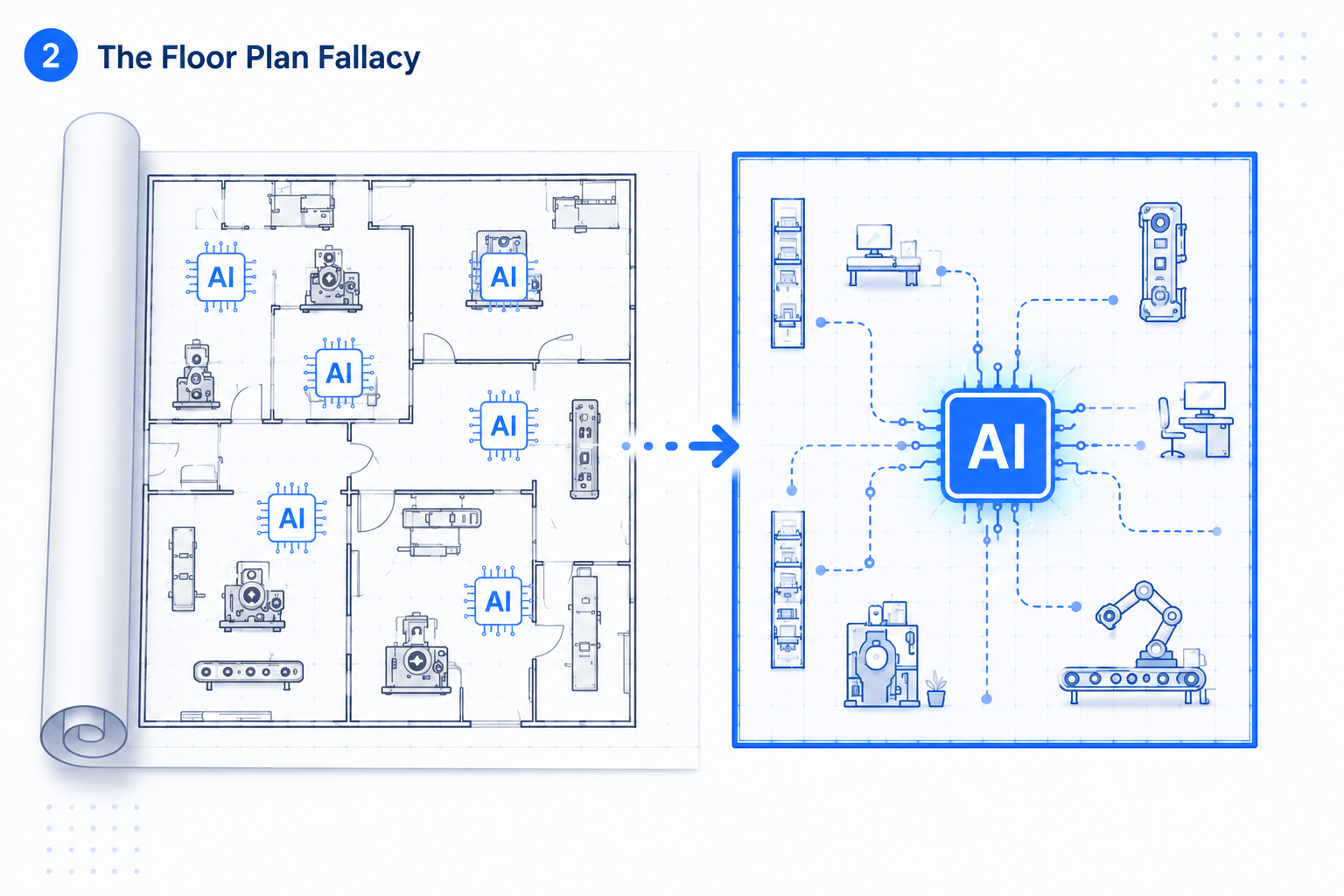
Consider the dawn of electricity. When it first arrived, it didn’t merely light up old factories. It led to a total redesign of manufacturing layouts. The early factories that chose to keep their old, steam-era floor plans and simply added electric lights eventually vanished.
Yet today, we are repeating the same mistake. Most companies are adding fancy electric lights to their steam-era floor plans and calling it transformation. They layer expensive new technology on top of broken, legacy processes and wonder why they aren’t seeing massive gains. True AI transformation is not about doing what you already do, faster. It is about completely rewriting your firm’s operating manual.
From Fixed Logic to Live Intelligence
To understand why simple “readjustment” fails, we must look at the economics of traditional software. For decades, software has done exactly one thing: take data input, apply fixed logic, and return an output. Writing that logic required human intelligence, and applying it at scale was the primary source of leverage.
However, fixed logic breaks on novelty. When an unexpected scenario arose, traditional software hit a wall, requiring human presence to resolve it. Over time, these manual workarounds evolved into teams, departments, and eventually entire layers of management. Our headcount, slow response times, and hourly billing models were never deliberate design choices—they were workarounds for a technical limitation that is now rapidly disappearing.
AI changes the core equation by shifting what gets applied from fixed logic to live intelligence. While fixed logic matched inputs to rigid rules, AI reads context, reasons across it, and acts. This mimics the exact cognitive loop a human runs, but without the human needing to be present.
Where traditional software codified what experts knew, AI codifies how they think.
Most business leaders are currently asking: “How do we use AI to do what we already do, faster?” But the winners will ask the right question: “What becomes possible now that intelligence is no longer expensive?” The gap between these two questions is where future competitive advantage sits.
The Bottleneck: Scattered Organizational Memory
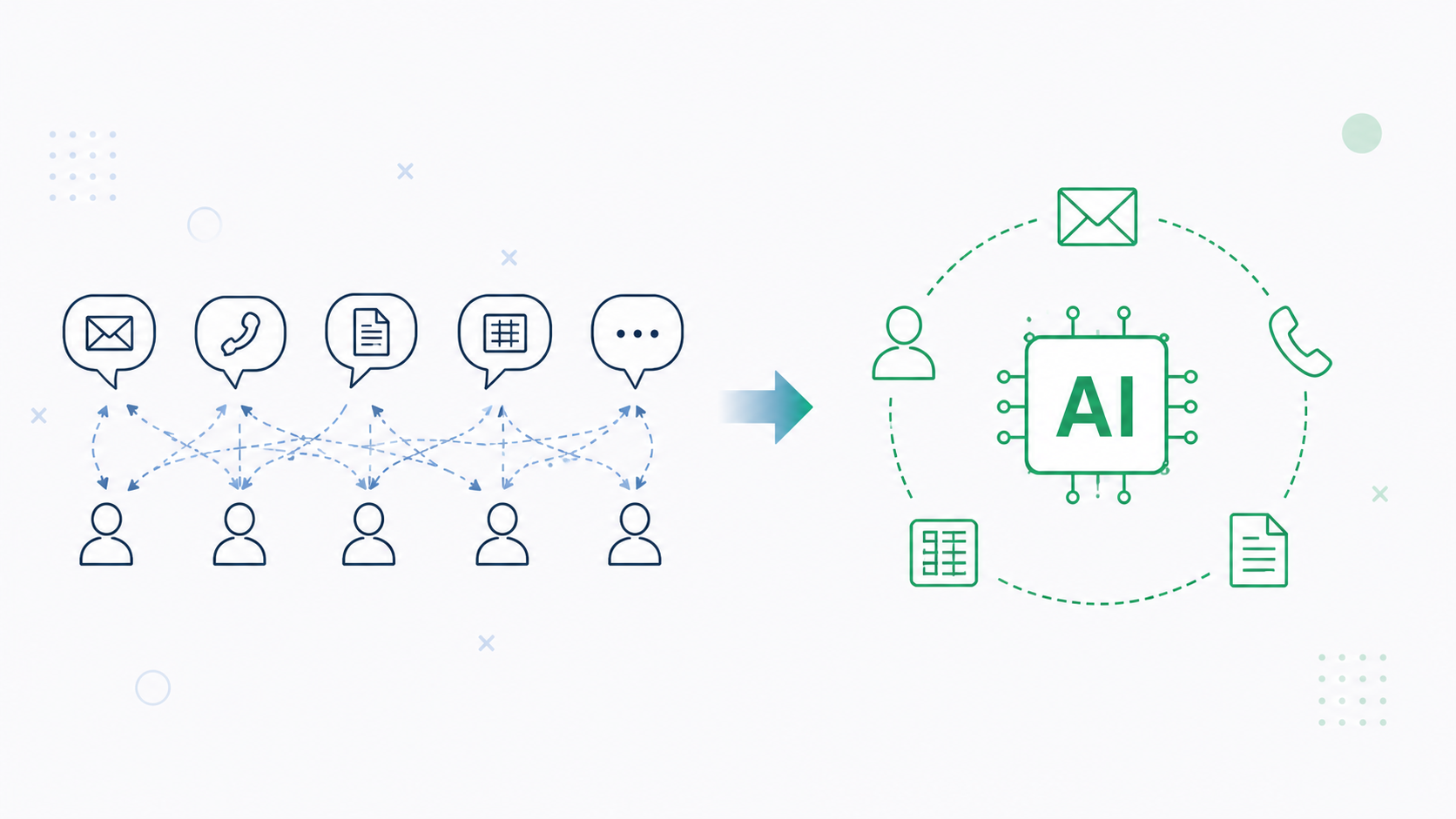
If the capability of AI is so immense, why are so many implementations stalling? The bottleneck is almost never the technology; it is your organization’s context problem.
In nearly every modern company, critical organizational memory is scattered across platforms, documents, chat channels, and meetings. Vital knowledge sits in the heads of individual employees who could walk out the door next month. The information exists, but it is not readily available.
AI is perfectly capable of structuring this mess, but it cannot feed on what does not exist. The real bottleneck is a lack of institutional practice. Most teams have never built the habit of capturing, documenting, and structuring institutional context in a shared, searchable way. Now that AI has made that proprietary context incredibly valuable, companies realize they have nothing to feed the model.
Your AI is only as good as the proprietary context you build around it.
To win, organizations must construct a central institutional intelligence layer. This layer ensures that every decision, every lesson, and every piece of context your organization has ever generated is surfaced exactly when a team member needs it. The companies that build this context engine will make informed decisions far faster than their competitors.
The Dangerous Illusion of Layering AI on Broken Workflows
Even if your organization builds a rich context engine, it will stall if that context is fed into broken, unmapped workflows.
Many founders and executives are in a frantic rush to deploy AI tools. It only amplifies the mess.
When workflows are undocumented, data is fragmented, and the same task is done five different ways by five different people, you cannot automate safely. You cannot automate what you do not understand.
This is why an AI Process Audit must precede any implementation. The organizations that have the discipline to audit first discover immediate, unexpected value. Before a single AI tool is selected or a single line of code is written, a thorough audit helps you:
- Eliminate years of hidden operational inefficiency.
- Clean up fragmented data that is silently corrupting your business reporting.
- Close security and compliance gaps that would derail any future implementation.
- Shift your team’s mindset from fearing AI as a replacement to actively demanding it as a tool to relieve their operational bottlenecks.
An AI readiness audit puts you on the road of making your business legible, laying bare where you are slow, where your data is exposed, and where a lean, AI-native competitor could easily disrupt you.
The Role of the AI Translator
Successful transformation does not happen in a silo. AI creates exponential value at the intersection of three critical pillars:
Very few organizations have individuals who can naturally navigate all three. Your IT team understands the technical systems, and your business teams understand the operations, but the real transformation opportunities live in the spaces between them.
Before you can implement, you must translate. This requires an AI Translation phase to identify high-impact opportunities, establish realistic priorities, and avoid incredibly expensive, vendor-driven mistakes.
As you navigate this translation, your primary human directive must be to protect the work your people find meaningful. True ownership and commitment live where people feel creative and valued. Let automation target the monotonous, soul-draining, repetitive tasks that nobody enjoys. When employees see that AI is being brought in to elevate them rather than replace them, you bypass the psychological barriers that derail most corporate IT projects.
Rebuilding Your Floor Plan
The technology is ready; the primary bottleneck is human and operational readiness. If you are ready to stop adding electric lights to your steam-era floor plans, the path forward is clear:
The floor plan is your starting point. Audit it, tear down the legacy walls, and construct an AI-native variant of your business that your current operational architecture cannot even imagine.