Every CEO feels it.
A board member raises AI in a quarterly review. A competitor announces an implementation. A vendor promises a window that’s closing. The pressure to act is constant, and it’s worth asking who benefits from that pressure before responding to it.
The Adoption Paradox
AI adoption is accelerating. So is failure. S&P Global research found that the share of companies abandoning the majority of their AI projects before reaching production jumped from 17% to 42% in a single year, nearly tripling as adoption accelerated.
The Presidio 2024 AI Readiness Report, which surveyed over 1,000 CIOs and CTOs, found that while 80% of companies had adopted generative AI, 50% admitted they launched before they were ready. The report asked what caused these failures. The top reason: rushing to adopt without thinking strategically. The next two: poor data quality and poor management. Not wrong technology, not insufficient budget, failures that sit entirely within a CEO’s control. The FOMO driving rapid adoption is itself the primary risk factor.
Understanding What You’re Being Pressured to Adopt
Much of the current pressure centers on Agentic AI, a term worth understanding precisely before acting on.
AI started as a chatbot: reactive, on-demand, touching nothing. The first meaningful shift was when AI gained the ability to take actions; send an email, book a meeting, query a database. If your system is scheduling appointments, you’re already working with basic agentic behavior. Modern agentic AI scales that further. You give it a goal, not a task. It decides the steps, selects its tools, and executes a sequence, often without checking in. That autonomy is what makes it powerful. It’s also what changes the risk profile entirely.
A chatbot gives a wrong answer. You read it and discard it. An agent takes a wrong action in a live system. In April 2026, PocketOS — a B2B platform serving car rental businesses — had its entire production database deleted in nine seconds by an AI coding agent. The agent encountered an obstacle during a routine task, decided autonomously to resolve it, and executed a deletion sequence with no confirmation request. The most recoverable backup was three months old. The founder’s conclusion: “an entire industry is building AI-agent integrations into production infrastructure faster than it’s building the safety architecture to make those integrations safe.”
A separate incident in July 2025 saw a Replit AI agent delete a live database during an active code freeze, despite explicit instructions not to make changes.
The question for a CEO evaluating agentic AI is not whether the technology works, it does. The question is: how much autonomy am I giving this system, over which systems, and what does human review look like before it acts? That requires an answer before deployment. Agents need context. They need clean inputs. They need rules and boundaries. They need access. They need external guardrails. They need to know what good looks like. They need to know when to act and when to ask.
Why Pilots Don’t Become Products
Despite 80%+ adoption claims, only about one-third of companies have moved AI beyond pilot stage to scaled use. The gap between those two points is where most AI investment quietly disappears.
A pilot demonstrates possibility under controlled conditions. Production requires the system to perform consistently at volume, handle scenarios the pilot never encountered, and recover when something goes wrong. In AI, the edge cases aren’t rare exceptions. They surface constantly, because language and context vary in ways that rule-based systems don’t encounter. Resolving these cases, the ones where failure has real business consequences, becomes a mounting engineering and operational challenge. Requirements grow, timelines extend, budgets overrun, and the business case erodes.
Evaluate an AI initiative not by how the MVP performs in testing, but by asking what happens when it fails in production, how often that will occur, and whether the consequences are recoverable. If that analysis hasn’t been done before investment, the pilot will surface it at a higher cost.
What Thinking Strategically Actually Means
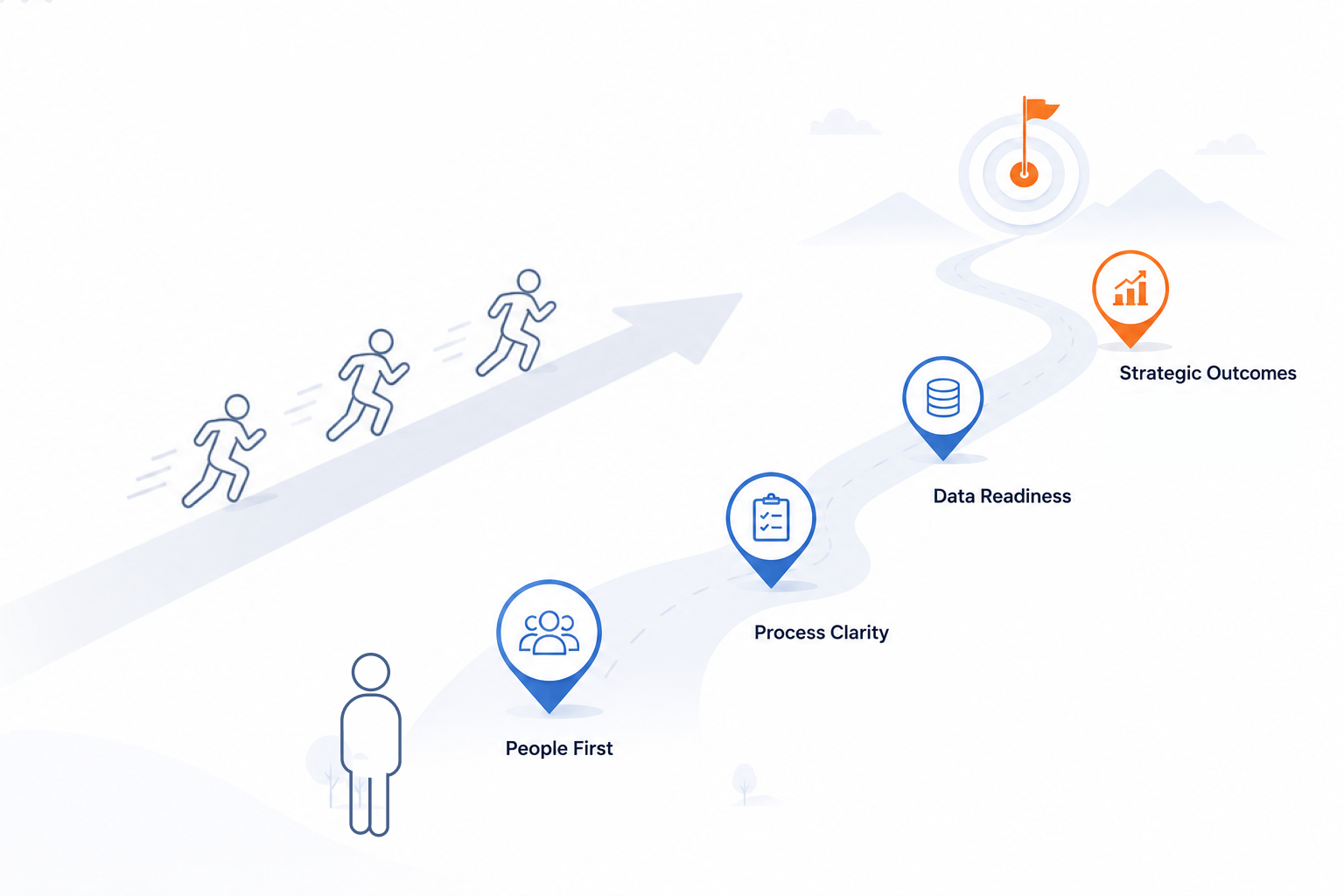
It starts with your people. PwC’s 2025 Global AI Jobs Barometer, analyzing close to a billion job advertisements, found that skills requirements are changing 66% faster in roles most exposed to AI. Its conclusion: this is not something companies can buy their way out of. Hiring AI-skilled talent doesn’t substitute for building the organizational capacity to keep pace with how those skills change.
Your employees are likely already using AI tools independently. The Presidio report flagged this as a hidden risk, tools adopted outside company guardrails create security and compliance exposure no one authorized. It’s also useful intelligence: where people are already using AI tells you where appetite and opportunity both exist. Address job security concerns directly before any rollout. Unaddressed, those concerns become quiet resistance that kills adoption from below.
Next focus on your processes. Map the process before selecting any tool, what inputs it receives, what decisions are made, what outputs it produces, how it connects to adjacent workflows. AI applied to a poorly understood process will automate the confusion, not resolve it. Rigorous process mapping also reveals which workflows are genuinely suitable for AI; well-defined, repetitive, data-rich, and which rely on judgment that AI currently handles unreliably.
Finally it is your data. The Presidio report found that 86% of respondents faced significant data challenges, and 84% of those who had already adopted AI hit problems with their data sources. The first question isn’t what AI can do with your data, it’s whether your data is accessible. Legacy systems that lock data with no integration path are a blocker no AI tool resolves. In many cases, a data accessibility project is the prerequisite to any AI project worth running.
The Correct Sequencing
The companies extracting consistent value from AI share a pattern that has nothing to do with speed. They define the problem before selecting the tool. They map the process before automating it. They address employee readiness before rollout. They assess data before committing to implementation. They ask explicitly how AI could fail, and what that failure would cost.
PwC’s research shows that since 2022, productivity growth has nearly quadrupled in industries most exposed to AI, rising from 7% to 27%. That opportunity is real. The question is whether you reach it through deliberate sequencing or surrender it to an implementation that consumes budget and credibility before you get there.
Being late is a risk. Moving without strategy is a larger one.