Table of Contents
Introduction
Part One — Orientation
- Chapter 1 — Flying Without Instruments
- Chapter 2 — The Tools and the Terrain
- Chapter 3 — You Are Here
Part Two — The Survey
- Chapter 4 — The Adoption Mirage
- Chapter 5 — Where Your Hours Disappear
- Chapter 6 — Problem-First, Not Toy-First
- Chapter 7 — Is AI Even the Right Tool?
- Chapter 8 — Can You Prove the Return?
- Chapter 9 — Does Your Knowledge Compound?
- Chapter 10 — Fast, Safe, and Not Slop
Before the Verdict — Your Tally
Part Three — The Verdict & the Route
- Chapter 11 — What No Audit Can Automate
- Chapter 12 — You Can’t Survey Your Own Terrain
- Chapter 13 — Your Starting Coordinates
Sources & Notes
Ground Truth
Most leaders are guessing about where their business stands with AI. Guessing is expensive. Getting it right is the moat, and it shows up on the top line. This guide is how you find out, and where to start.
This is how it works.
Thirteen short chapters, three parts.
Part One orients you. Part Two walks your business one dimension at a time — and each dimension ends with a Zone marker that helps you place yourself. Part Three tallies what you found and tells you what to do with it.
At the end of chapters, there’s a Ground Check — a single honest question and a quick read of what your answer means. Answer them as you go. By Chapter 3, you’ll know how to place yourself; by the end, you’ll know your highest-leverage first move.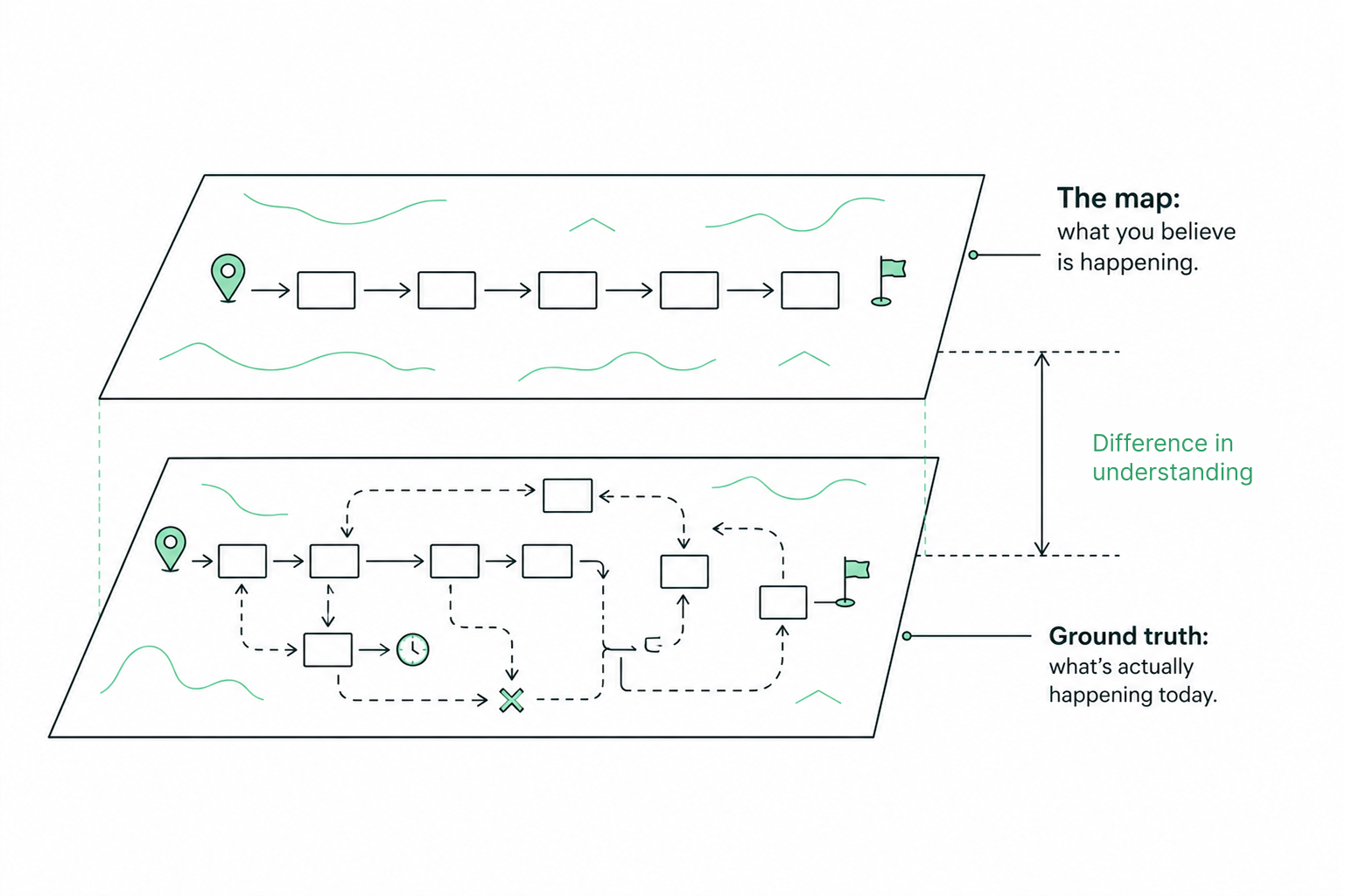
This guide is published by the firm that sells the audit it ends with. We think the reasoning holds up anyway (that’s why we put it in writing), but read it the way you’d read anything written by someone with a stake: skepticism switched on.
The self-checks in these pages are yours to keep and use either way, whether you ever talk to us or not.
No jargon. No tools to buy. Just an honest look at the ground.
Part One — Orientation
Chapter 1
Flying Without Instruments
Picture your closest competitor. Same industry, same size, same fiscal year. Same capex on infrastructure, same opex on headcount.
On paper, you’re twins.
Except they ship in days what takes your team weeks.
Not talent; you’d have poached it by now. Not budget; your P&L and theirs line up. Not even tooling; check their vendor stack, it’s the same logos in your own capex approvals.
The difference never shows up in the inputs. It only shows up in output, and by then the gap is already wide.
Here’s the uncomfortable part: you can’t see what you’re missing..
The numbers you trust (revenue, headcount, utilisation, opex efficiency) were built for a world where output scaled with people and hours. AI broke that link. A team can be staffed, on budget, fully utilised, and profitable, while quietly falling behind, because none of your gauges was built to measure AI leverage.
You’re flying across mountains. And the map you have is out of date.
This is why so many AI spends are disappointing, and the research is blunt about it.
RAND, after interviewing the engineers and data scientists who actually build these systems, reports that by most estimates, more than 80% of AI projects fail — roughly double the failure rate of ordinary IT projects.[1]
MIT researchers looking specifically at generative AI found something starker: about 95% of corporate pilots showed no measurable impact on the profit-and-loss statement.[2]
Yet McKinsey’s analysts estimate that with technology that exists right now, well over half of today’s work hours could technically be automated — their 2025 assessment puts the figure at 57% for the US.[3]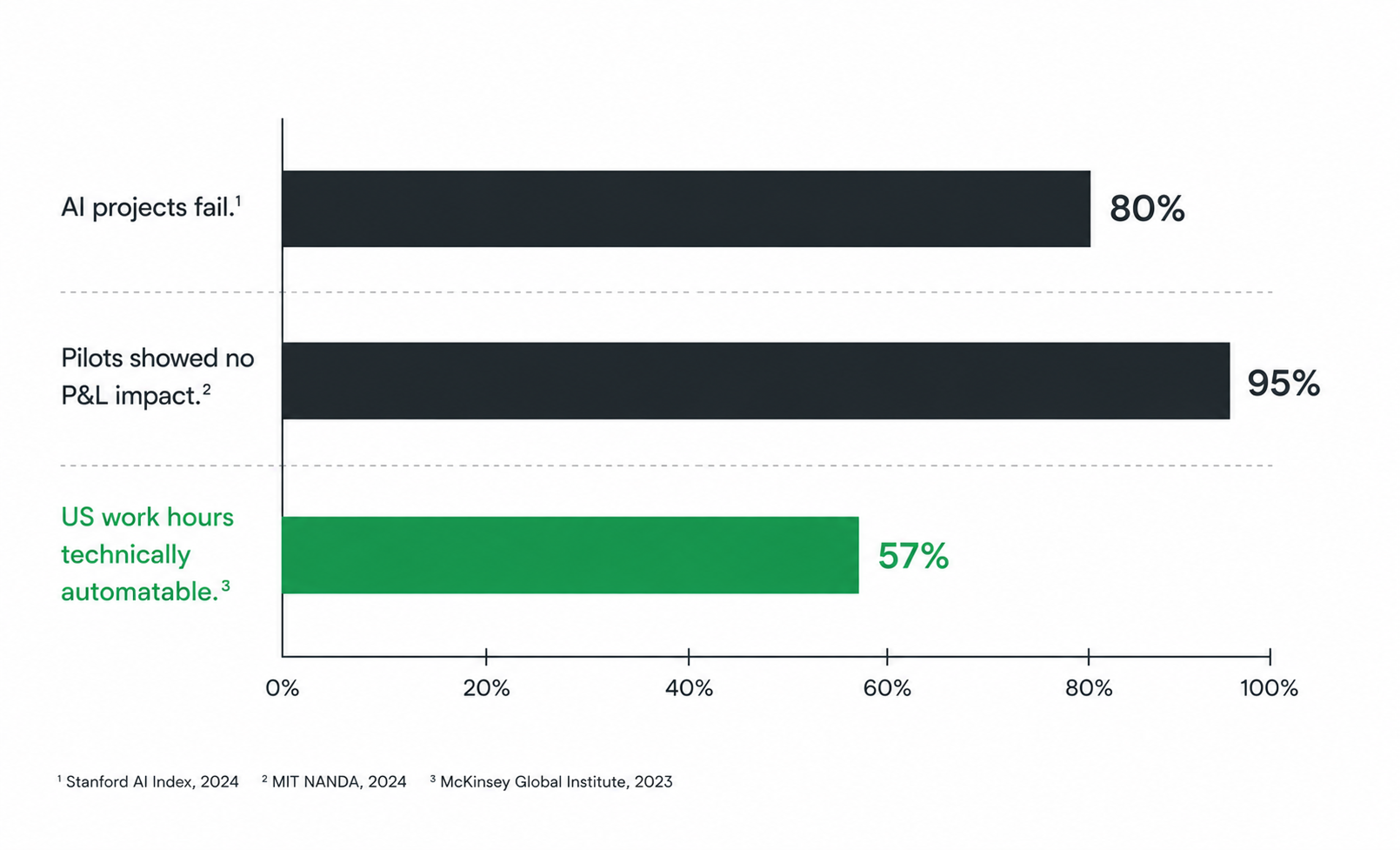
Read those numbers together. The problem is seldom that AI can’t do the work. The capability is enormous and mostly idle. The problem is that the effort goes to the wrong places: the tool that demoed well, the project someone got excited about — while the highest-leverage work sits untouched, in plain sight.
Over-invested in motion. Under-invested in what compounds.
Every leader runs on a map.
The map is what you believe is happening. How the work gets done. Where the hours go. What your team has actually adopted. What’s working.
Maps are useful. But they have a shortcoming. They are always drawn from how things used to run, updated by hallway summaries, smoothed by the natural optimism of everyone reporting upward.
Ground truth is the other thing. It’s what’s actually happening in the work, on the ground, today.
The distance between the two is your real readiness. And it’s almost always wider than the people at the top expect.
This guide is about closing that distance by walking your terrain one dimension at a time and asking, honestly, where you stand.
One honest note before your first score, because it matters for everything that follows. Every check in this guide is self-scored. You’ll be grading your own company, from your own seat, with the view your seat provides. Later chapters will show why that view runs optimistic — almost everyone does.
So treat each score as a sketch, not a survey. Sketches are still useful. They tell you where to look harder by going deeper.
Now — start with a simpler question than “are we ready.” Start with: Are you even feeling the friction AI is built to remove?
Run the list. Count the ones true for you right now.
Ground Check
- Your team spends more time on repetitive work than on judgment, thinking, or creating.
- The work that keeps your business running is still largely manual.
- Demand is growing faster than your team can keep up.
- Your team still manually moves information between systems.
- Routine work leaves little time for problem-solving.
- The cost of routine work keeps rising.
- Errors / Defects are affecting your customers and you can’t take the happy path to your destination.
- The same task gets done differently depending on who does it.
- Higher workload leads to slower service.
- Your experts are tied up with tasks that could be automated.
Count your yeses:
Zero to two: AI isn’t your biggest opportunity yet. Fix the business fundamentals first.
Three to six: you’re not just ready; the cost of standing still is compounding with every passing moment.
Seven or more: the question was never whether to act. It’s how the friction got this far before anyone measured it.
That number is your first coordinate. It tells you the pressure you’re under. It doesn’t yet tell you your position, where you sit on the path from no real adoption to a business rebuilt around AI.
You know the pressure. Now inspect the terrain.