





Customer support is the backbone of any successful business, but traditional contact centers face numerous challenges that can impact customer satisfaction and operational efficiency. From handling diverse accents and languages to managing complex routing decisions, contact centers need intelligent solutions that can adapt to modern customer expectations.
In this post, we explore how Amazon Connect, combined with Amazon Lex and Amazon Q, creates a powerful platform for building autonomous customer service workflows that integrate seamlessly with internal systems and CRMs while providing comprehensive analytics for business leaders.
The Contact Center Challenge
Traditional contact centers struggle with several critical issues that directly impact both customer experience and operational costs:
- Manual Process Inefficiencies: Human agents spend valuable time on routine tasks like identifying customer intent, looking up account information, and determining the right workflow. A customer calling about a billing issue might get transferred multiple times before reaching the right department.
- Language and Accent Barriers: With customers from diverse backgrounds, agents often struggle to understand different accents and pronunciations.
- Inconsistent Routing: Without intelligent routing, customers frequently end up in the wrong queue. A technical support issue might land in billing, requiring additional transfers and increasing wait times.
- Limited Knowledge Access: Agents juggle multiple systems and knowledge bases to find answers, often putting customers on hold while they search for information across different platforms.
- Poor Visibility: Management lacks real-time insights into contact center performance, making it difficult to identify bottlenecks, measure agent effectiveness, or optimize operations.
These challenges result in longer resolution times, higher operational costs, and frustrated customers who might abandon their calls or escalate to social media complaints.
The Intelligent Solution: Connect + Lex + Q
Amazon Connect, enhanced with Amazon Lex for natural language understanding and Amazon Q for generative AI capabilities, addresses these challenges by creating an intelligent, automated customer service platform.
- Amazon Connect serves as the cloud-based contact center platform, handling voice and chat interactions with built-in telephony, queue management, and routing capabilities.
- Amazon Lex provides natural language processing to understand customer intent, even when speech recognition isn’t perfect due to accents or background noise. It can identify whether a customer needs account support, technical help, or billing assistance.
- Amazon Q brings generative AI capabilities to assist both automated workflows and human agents. It can access knowledge bases, generate contextual responses, and provide intelligent recommendations based on customer history and current inquiry.
Together, these services create workflows that can autonomously handle routine inquiries while seamlessly escalating complex issues to human agents with full context.
Solution Architecture and Workflow
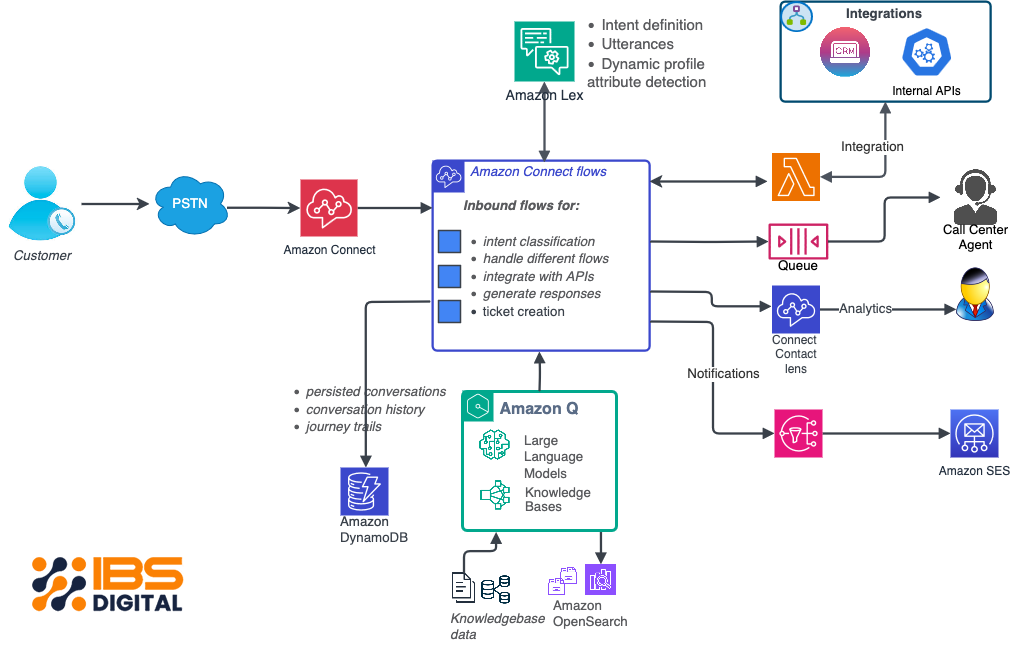
Core Components
Customer Entry Point: Customers connect via PSTN (phone) or web chat, entering through Amazon Connect’s unified interface.
Intent Classification: Amazon Lex processes customer utterances, identifying intents such as:
- Account-related inquiries
- Technical support requests
- Billing questions
- Product information needs
Intelligent Routing: Based on identified intent, Connect flows automatically route customers to:
- Automated workflows for simple requests
- Specialized queues for complex issues
- Appropriate agents with relevant skills
Knowledge-Powered Responses: Amazon Q leverages large language models and organizational knowledge bases to:
- Generate accurate responses to customer questions
- Assist agents with relevant information
- Provide step-by-step troubleshooting guidance
System Integrations
API Integration: AWS Lambda functions orchestrate workflows and integrate with:
- Internal business systems
- Customer databases
- Product management APIs
- Inventory systems
CRM Integration: Automated ticket creation and customer record updates ensure that all interactions are properly documented and tracked.
Notification System: Amazon SES handles email notifications, keeping customers informed about case status and resolution updates.
Data Persistence: Amazon DynamoDB stores conversation history, customer interactions, and workflow outcomes for future reference and analytics.
Analytics and Monitoring
Contact Lens Analytics provides executives and managers with comprehensive dashboards showing:
- Call volume trends and patterns
- Agent performance metrics
- Customer satisfaction scores
- Issue resolution times
- Sentiment analysis from customer interactions
Key Capabilities
Autonomous Workflow Execution
- Account Verification: Automatically validate customer identity using phone numbers, account details, or security questions
- Order Status: Retrieve and provide real-time order information from integrated systems
- Basic Troubleshooting: Guide customers through common technical issues using Q-powered diagnostic flows
- Appointment Scheduling: Integrate with calendar systems to book service appointments
Intelligent Agent Handoff
When automation reaches its limits, the system seamlessly transfers customers to human agents with complete context:
- Customer information pre-populated
- Conversation history available
- Suggested actions based on intent analysis
- Relevant knowledge articles surfaced
Omnichannel Support
While initially focused on voice, the architecture easily extends to:
- Web chat integration
- SMS/text messaging
- Social media channels
- Mobile app integration
Implementation Approach
Phase 1: Foundation Setup
- Configure Amazon Connect instance
- Set up basic IVR flows and queue management
- Establish telephony and user accounts
- Configure initial routing profiles
Phase 2: AI Integration
- Deploy Amazon Lex for intent recognition
- Integrate Amazon Q for knowledge retrieval
- Build Lambda functions for API connectivity
- Test automated workflows
Phase 3: System Integration
- Connect internal APIs and databases
- Implement CRM integration
- Set up notification systems
- Configure data persistence
Phase 4: Analytics and Optimization
- Deploy Contact Lens analytics
- Create executive dashboards
- Establish performance monitoring
- Implement continuous improvement processes
Business Benefits
Improved Customer Experience: Faster resolution times, accurate routing, and 24/7 availability for common inquiries.
Operational Efficiency: Reduced agent workload for routine tasks, allowing focus on complex customer issues that require human expertise.
Scalability: Cloud-based architecture grows with business needs without significant infrastructure investment.
Cost Optimization: Automated workflows handle high-volume, low-complexity interactions, reducing per-contact costs.
Data-Driven Insights: Comprehensive analytics enable continuous optimization of processes and performance.
Conclusion
By combining Amazon Connect’s robust contact center platform with the AI capabilities of Lex and Q, organizations can transform their customer support operations from reactive, manual processes to proactive, intelligent workflows.
This integrated approach not only improves customer satisfaction through faster, more accurate service but also provides the operational insights needed to continuously optimize performance. The modular architecture ensures that the solution can evolve with changing business requirements while maintaining the flexibility to integrate with existing systems and processes.
For organizations looking to modernize their customer support operations, this AWS-powered solution provides a clear path toward intelligent, scalable, and customer-centric service delivery.